Showing posts sorted by date for query Hunchback of Notre Dame. Sort by relevance Show all posts

Wednesday, July 15, 2020

Anatomy of a Circus...part 2

Anatomy of a Circus...part 2


( Circus 1930 - Pencil detail of teddy bear of that era and bare feet )


Story telling
 My years of training in feature animation exposed me to the story telling process. Illustration is also storytelling.  Every detail of an illustration, animation, live action movie or a play, has to be planned and executed properly.
 Questions have to be asked in the beginning of the project. Is this the best way to showcase the subject? What are you attempting to communicate? What do you want the eye to focus on? Ae you leading the eye in the proper direction? Are there interesting stories being told within the context of the whole storytelling process? Will the composition stand up from a distance; from midway and up close?...Where is the best placement for a character? What best tells the story of each individual? Is that character drawn in such a way as to convey enough information to make him/her interesting? Are the situations the characters are engaged in entertaining to the viewer?

These and other questions are asked along the way as the composition builds.

I treat every character in an illustration as an individual with his or her own story to tell. I put enough drawing information for the viewer to draw their own conclusion. In this way the audience develops an emotional tie to the illustration.

"quicksketchillustrationanimation"...
Not a real word but a concept I use in teaching and at workshops in an attempt to convey to students the idea that there is overlapping of these three forms of communication. The same principles that apply to one, are applicable to the other two.

The list...

This list compiles the things I look for in a quick sketch, an illustration, and in animation.
Not all apply to the three disciplines in every category, but the majority do. For example...Is the character in balance? Does the character have weight? Is the character in silhouette? Is the anatomy right? Does it read from a distance and up close (composition)? Can you tell what is happening? Are you drawn in emotionally? And more...

In quick sketching and illustration, a story is told in a single drawing. Animation serves up the same set of questions (above), only in motion. In animation, a story is told with a series of individual drawings in an illusion of movement. Your job is to decide, regardless of the medium, how best to communicate the story.

The role of the thumbnail sketch...
Thumb nail sketches of Djali (below) the goat from Hunchback of Notre Dame and Dr. Sweet (below right) from Atlantis:the Lost Empire.

These thumb nails are what I refer to as glorified quick sketches, with the purpose of guiding me in planning a scene. Quickly and in miniature I can visualize some of the items on the list. At this juncture silhouette and staging are the most crucial. In the next step, approximate timing is addressed.

Notice the numbers under the Djali sketches. How much time would take to go from one key pose or drawing to another?


(Final scene in color minus the background )


This same  approach was taken as I worked out the 'business' of Dr. Sweet in key poses as he shakes hands with Milo, walks over to his desk, puts on his lab coat, reaches into the medical bag and pulls out a bone saw.

(Thumb nail drawings of Dr. Sweet's introduction.)


An example of quickshetchingillustrationanimation in action...

From these quick sketches (below), can you spot how many items on the list apply?

Anatomy, silhouette, primary/secondary action, positive/negative shapes, squash/stretch etc.

Any one of these sketches could  be used as a preliminary drawing for an illustration; just add the details of a face, number on the uniform, etc.
(layout courtesy of Tom Shephard)
These quick sketches could also be used as animation poses. In animation these five  sketches would be referred to as extreme or key poses. Add drawings between these keys and you have animation. How many drawings there are between the key poses depends on the timing of the scene. The more inbetweens, the slower the action. Less inbetweens will speed up the scene. This is referred to as timing.

An idea brought to fruition......
Decades ago I chose to focus my attention on images of Black Americans of African descent residing in the southern parts of the United States in the 1930's. My Mom furnished me with images of her childhood in Mississippi. Relatives and friends from that region watered my imagination with their stories and an occasional Caucasian would add fuel to the fire of thought describing their impression of the locale. The Funeral (Anatomy of a Circus, Part 1) is an example of one of these discussions.
A colleague at Disney Feature Animation described his trip through the south. The verbal picture he  painted was one of people gathered in groups outside a church as he drove by. This was enough for me to get my creative imagination started.

Woman at Stove
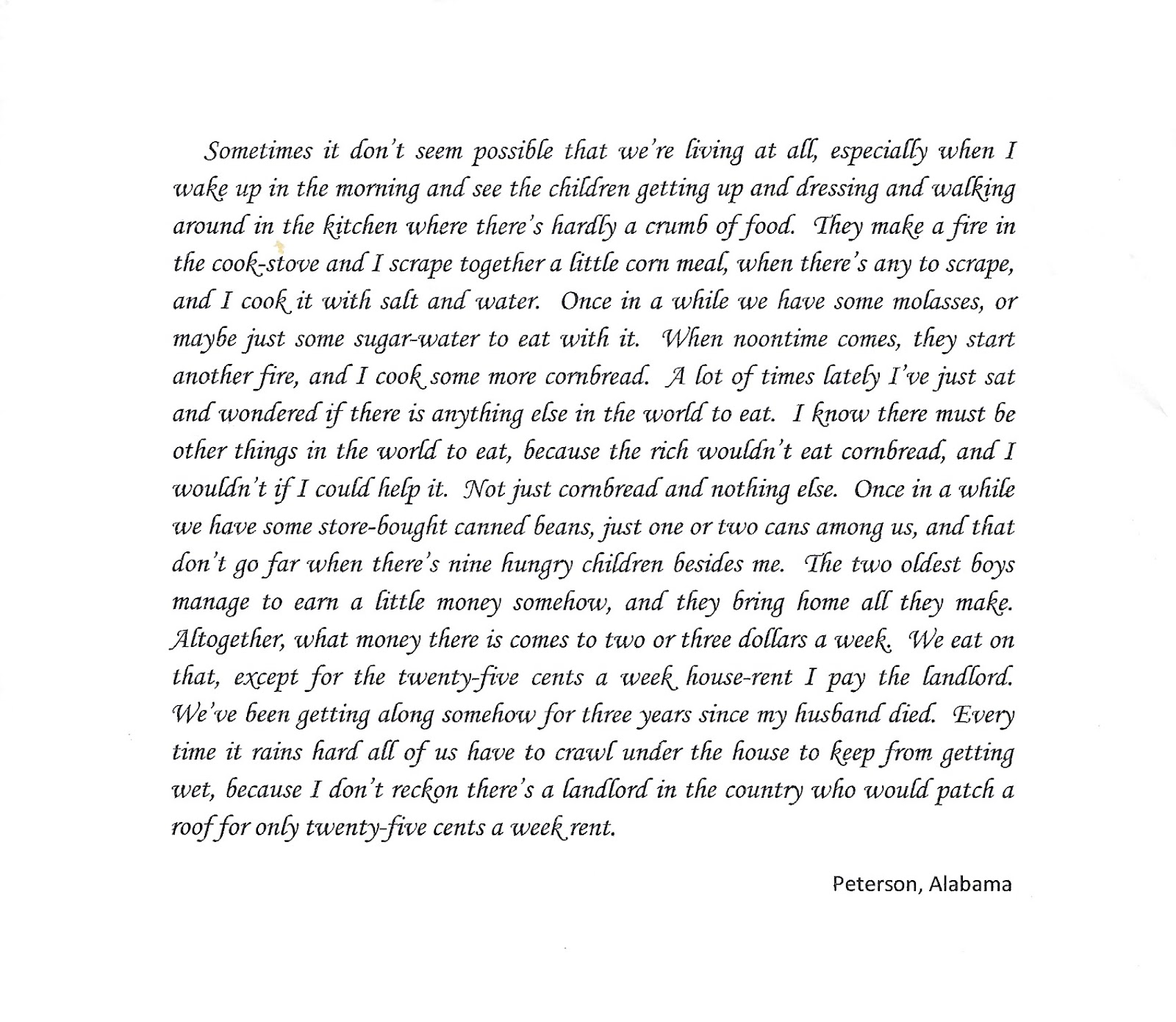
Late 1960s/early 70's I created the pen and ink (below) inspired from a photograph and years later found text that I thought appropriate to mirror the emotional experience. I framed both together.
(Woman at Stove pen and ink 8 1/2" x 11 1/2")

.         


What I attempt to do in my illustrations is to capture that kind of emotion (above), only without text.

 Anatomy of a Circus...
(Photo that inspired the idea for Circus 1930)


 The inspiration for my artwork is typically born of ideas that have been in my mind for years. I'll see a photograph and file the image away in a folder with the thought, "this has potential." It will lay dormant for years in most cases and sit quietly until inspiration and or the right circumstances calls it to the forefront.  Over a period of time something will click in my minds eye and the possibilities will start to come together as to what is the best way to present the idea.

Research...
Research is first in order of priority. I learned this from my time at Disney animation.
Knowing the 'real' brings an air of authenticity to your art work. Walt Disney said "Only if he knows the reality of things can he create a fantasy, an illusion or a caricature convincingly".
For example, we animators visited the San Diego Zoo in preparation for animating the many animals in The Lion King. I also paid a visit to Disneyland (CA) when they kept small farm animals behind Big Thunder Mountain (present day Star Wars Land) to see live goats for reference in the animation of Djali in Hunchback of Notre Dame.

Additionally, I traveled to Montana in 1999 to observe elk in their natural (winter) in preparation for the animation in the Firebird Suite for Fantasia 2000.

Personal experience...
Like many of you, I have personal memories of times at the circus.
As a kid I wandered around property that had been transformed overnight into circus grounds, sat under the big top, seen clowns and barkers at their booths, stared wide eyed at abnormalities of human and animal nature then referred to as freaks, smelled the musky odor of circus animals and their droppings, ate cotton candy, and rode the Ferris Wheel.

Along with this first hand knowledge I also had to transport myself into the rural south of the 1930's. Books, magazines and photos of circuses of that era filled the blank spaces in my minds eye.
Circus clothing of that era would add authenticity to the piece. Circus apparel, like all fashion have gone through changes throughout the years. Clown attire and make-up has also morphed over the years. These observations must be reflected in the illustration. Watching the Turner Classic Movie  (TCM) channel gave me insights of how fabrics and textures were handled for black and white film and for my purpose, to translate black ink on white paper.

Let's start dissecting Circus 1930...
                                   
What comes to mind when  the word circus is thought of?...A parade of characters advertising what is within the big top...exotic animals...clowns:big and small...people:big and small...animals: dressed up and trained...a Ferris Wheel...a strong man...unicycle riders...and more.

The circus setting is the backdrop, the people are the real story.
What is the best way to communicate their stories? What is the best way to communicate this idea?
A series of 'thumbnail' sketches will  answer these questions as well as spawn new ideas of presentation. This is the same process used in planning an illustration or animated scene (see above thumb nail sketch).

 Planning keeps mistakes to a minimum ensuring nothing happens by accident.

The illustration will eventually be 23" x 29".  Proportional dimensions of the illustration board are drawn in (rectangle shape below). This will help me visualize the composition.

(Photograph  dimensions 8 1/2" x 11")
Diagram chart (below) to size on vellum paper with people. This will help me keep proper proportions in the position of characters to the background elements.


These thumbnail sketches (below), properly referred to as primo pensieri or 'first thoughts' are my first thoughts sketched on paper. The elephant (below) will play a major part in this illustration. All other characters would revolve around him.

The question is what would be the best way to present this species of pachyderm?...walking towards, left to right or away from view or maybe doing a hand stand? should the animal be a baby or adult and offspring?

An early idea, which I thought entertaining, was to have a clown being pulled along as he held on to  the elephant's tail.


Exploring ideas (right) of clowns, a circus wagon, circus workers and elephant direction.


More thumbs (below right) led to the idea of the elephant moving away from the viewer.


Originally the strong man was to be carrying a tiger.
 (A man carrying a full grown lion is no stretch of the imagination. The image is based upon a 1930's photograph of a female circus performer with a tiger draped on her shoulders, only she faced the camera. If  a female could do it, surely the circus strong man could.)

As I worked through the composition, placement of these two would be altered from the sketch.


Alternate character possibilities, costumes and composition (below).


The trainer and bear (above) are from a photo. Even working from an photo you want to make an image more interesting. Having the subjects in action added interesting detail to the final product.

Brainstorming (below). Ended up using some images and some were not used. Yielded a pony, riders, crying children, clowns, a puppeteer with marionette, interesting situations , details of the wagon, more character possibilities and size relationships.


My imagination bursting at the seams with fresh ideas on how to 'push' these thumbnail drawings and squeeze out their potential.

Eric Larson, Disney Legend as an animator and instructor to my generation stated "the only limitation an animator has is his imagination and his ability to draw what he imagines".


Until next time...


Until next time...

Tuesday, March 10, 2015

Finding a home in Fantasia...


May 1996...
  After animating on Hunchback and prior to Hercules, my curiosity got the best of me and I trained in CGI in preparation to animate on the then called Dinosaur Project (released as Dinosaur). Thoroughly enjoyed the training experience, but after about six months I missed 'pushing a pencil' . After a conversation with director Eric Leighton in which I explained how much I missed drawing on a daily basis, I left the project.

(Me training on computer for The Dinosaur Project...)


  During this time I continued being a spokesman for Disney animation. My first opportunity to do this came while animating on The Black Cauldron. I spoke to an elementary school for their career day in Victorville, CA. As 'Guest Speaker' I would get many more chances to talk about my passion and love for this art form. These speaking engagements would help hone my skill and quiet my nervousness in years to come:-)

(Me as 'guest speaker'...)


   Attached to no production I wandered aimlessly around the studio in search of a project to latch on to.  Hercules, in need of animators to complete the feature brought me on board.

January 16th 1997...

  The animators who worked on Hercules started off the year with an appreciation luncheon in celebration of  the features' run in the theaters the past few months.


January 20th 1997...

  After my brief venture into and out of the world of CGI and the short stint animating on Hercules, I was once again without a production home. Wandering through the hallway of one of the many buildings Disney occupied on Flower St. in Glendale and looking at storyboards of the then called "Fantasia 99", Paul Brizzi walked by.We engaged in a conversation about the boards. The storyboards outlined Stravinsky's Firebird Suite which Paul and his twin brother Gaetan were preparing to usher into production as directors of this segment of the newly revised Fantasia.

Fantasia...
  Released in 1940, this piece married classical music with animation. The original intention was to take out a piece and replace it with another musical number every few years. By this time there should have been all new segments in place. Things did not go as planned as other studio priorities came to the front of the line. But, now it was time.

    Paul walked me through the story boards and my interest peaked. John Pomeroy was to animate the Firebird and Tony DeRosa the Sprite; the only other character was the Elk. I wanted to animate the Elk and voiced my desire. Paul wanted to see what I could do with a four footed character before he would consider me animating on this ungulate. I dropped off my reel of Djali tests done for The Hunchback of  Notre Dame for the brothers to look at. A few days later I got a call welcoming me on board. I found a home:-)


The Elk...

  As ruler of the forest the Elk was to show strength, majesty, courage, encourage another (Sprite) and be regal at all times...without dialogue. Body language and timing would be the rule.

  In addition to these spiritual qualities, the Brizzi brothers had a particular physical kind of elk in mind. Of the three kinds of elk in North America, the largest of the species, the Roosevelt Elk, embodied the brothers vision.


Getting started...

  My research of articles, video and photographs had yielded plenty of information.

(Information from books and articles.)


(Hoof placement of rear right leg in walk)

(top:Thumbnails of first rough test)

 Thumbnail studies gleaned from video and photographs.


No substitute for the real thing...

   Stepping away from the books, a trip to the local LA Zoo would finalize my information quest and then I could start animation.

   A couple of problems emerged. There were no Roosevelt elk locally and any in California zoos had already shed their antlers (they would grow back at a rate of 1/2 inch  a day for months producing a 50"+ rack).

 How could I draw live elk with full antlers; observe them in their natural habitat and touch them up close?  Simple, go where they are. Unfortunately, calls to zoos and wild life habitats in Southern California were fruitless. Northern CA, same results. Up the coastal states of Oregon and Washington, nothing there.

  Finally we hit the jackpot...the Nybee Elk farm...in Montana...in January...28 degrees below zero.

Bundle up, here we come.

  Paul Brizzi, Fred Herrman and I flew out of  Los Angeles to Denver, CO. From there we took a small plane to a small airport in Idaho. A car was rented and Fred drove us across the state line to Plentywood, Montana where it was 28 degrees below zero at night (it warmed up to 14 below during the day:-)                                                    
                                                                                   
(Our small plane and Fred and I on board)
(Elk outside the van.)


    A van was rented with big side windows. The elk were fed outside the vehicle so we could get a good look at them. With the heat going full blast, I sketched away.                                                                
(Up close and personal...)


  These antlers would be harvested (cut off) while still covered with a furry skin referred to as 'velvet' which has a blood supply to support the fast (up to 5 ft. in two months) growing antlers. They were then sold, usually to foreign markets for medicinal and other purposes.


Our newsletter, The Twilight Bark chronicled our visit in pictures.


(A little below zero humor and I did bring back an antler)

  My cartoon, which was included in the article, is based on true events. We'd walked across the street from the hotel where we were staying to get breakfast. We entered the restaurant and the diners are all in short sleeve shirts and we are dressed like Ralphie's brother in A Christmas Story. They had a good laugh on us as one guy asked "Where you boys from...Florida?"


to be continued...

Wednesday, January 28, 2015

Hercules...


Summer of 1996...

  came to an end with the launch of The Hunchback of Notre Dame. The animation newsletter, the Twilight Bark heralded the Passing of the Torch to the production Hercules which had been in the works for some months.


Yes, there was a figurative and literal torch being passed from completed production to the next in line :-)


   At that time multiple productions were being done concurrently with the aim to release a Disney Feature film every year.  Fantasia 2000 was in development. It was then known as Fantasia Continued ( and Fantasia '99) and Disney's first venture into 3D Animation, the Dinosaur Project was perculating.
 
But, for now it was Hercules' time to take the spotlight.

Coming over from CGI training for the Dinosaur project (more on this later), I was asked to 'lend a hand' to help Hercules to the finish line. By this time much of the primary animation had already been completed. I got a screen credit for the Titans and Cyclops, but in reality, I did a variety of characters (and none of the Cyclops:-)


(Chariots and animals  of the gods)
Thumbnails of various scenes I animated...

(Fans climbing gate to get to Hercules residence)


(Storyboard for series of scenes where running horses are frozen by one of the Titans)


(Thumbnails working out the action of the horses)


  Lending a hand to finish a production was nothing new for me. On my first feature Rescuers, everybody pitched in as that feature came to an end. We animators did clean up, effects and anything else needed to complete the production.

  On Fox and the Hound my primary animation was on Chief and some adult Copper. After all the character animation was completed, I, like the other character animators did whatever else was needed to finish the film.  I did some clean up and special effects animation. We tried to avoid cleaning up our own rough animation, though it was not always possible.

  I added the leaves effects to a Big Mama scene...The one where she is carrying out a pile of leaves and dropping them to the ground with one leaf settling on Todd's head.

I also animated the close up of the stick and bear trap being set off by a close up of Amos' hand and some ground being splattered by shotgun pellets.  And if you're wondering, Yes...I do remember pretty accurately each scene I've ever worked on (got the thumbnails to prove it).

 As the years passed, helping out in other areas became passe as the animation department expanded with an abundance of specialized personnel in every department.

Also during the time, Ebony Magazine ran a short article about Wes Sullivan (rough inbetweener) and my contributions to Hercules...

(Ebony Magazine article title)

(Wes Sullivan and me)


The invitation to the Hercules screening and wrap party signaled the productions' end...and the beginning of the next. (Up next... (for me - Fantasia 2000).


Monday, December 8, 2014

The Hunchback Of Notre Dame and more...part 4

February 1996...


 The animation for The Hunchback of Notre Dame comes to a conclusion...


Then, in April 1996...

The company newsletter informs us there will be a Super Premier at the Superdome in New Orleans, Louisiana for Hunchback.


May 1996...  The animation crew and their families are invited to the Big Easy for the Premier and other festivities...


June 1996...

The traditional cast and crew party was held here in Los Angeles...


(LaVonne and me with Quasimodo at the cast and crew party)


Three days later we boarded a chartered plane for New Orleans...


(Melissa, LaVonne and me as we are about to board the plane)

The crew and our families at LAX.


LaVonne, my daughter Melissa, and me as we boarded the plane. Melissa, back for the summer from her freshman year of college at Spelman, was the only one of our three kids still at home...


My sons; Jai, coming from Morehouse College in Atlanta, GA and Mikel, from Howard U in Washington, DC, met us in New Orleans.

(Me, Jai and Mikel in the hotel lobby)
Let the fun begin...


Above left, our day-to-day guidebook to the fun and festivities in New Orleans...And above right, anticipating the heat, a fan to cool off from the sweat worked up from the planned activities. 

First up, dinner at the Gallier Hall (old Mayors Mansion) with it's beautifully decorated rooms, and delicious food prepared by chef Paul Prudhomme.  And then...

(About to enter the Gallier Hall)
we walked, led by a small band, to the Spanish Plaza where we boarded  the Riverboat Cajun Queen for dessert as we floated on the Mississippi River.

(About to walk to the riverboat)

 The next day...


 We were bussed to Jackson Square for The Hunchback of Notre Dame Parade..


(Jai, Melissa, me and Mikel in the grandstands)

(Our point of view from the bleachers)


Finally, we were bussed to the Superdome to join 60,000 plus animation fans for the Pre-Show, Premier screening, and Reception.

The Bark spotlighted our time there.


The month of June ended with a news article focusing on the contributions of African-Americans in the making of The Hunchback of Notre Dame. To some it may not seem like anything to make a fuss over, but there is not a lot of exposure to art in general in the black community. Sports and entertainment (singing, dancing etc.) yes. The Arts, no. Even in the sports field the list is short in certain arenas. Can you name a black swimmer? A black golfer, chess, rodeo? One or two at the most.


Exposure is one way to get the word out that there are avenues to creative careers in the arts to diverse communities.

  Though we are all listed as animators in the headline, each one of us played a separate part in the production of the film.

 Lillian Chapman in the clean-up department working on my character Djali.

Serge Michaels painted backgrounds.

Marlon West is credited with visual effects and
Marshall Toomey was Lead Key in the clean-up drawings of Quasimodo.


The Bottom Line...

 After all of the fanfare ushering in the production, the focus then becomes, "How well will the feature do at the box office when released? Will it make back production costs? Will it turn a profit? Can the studio afford to make another animated feature?

 These are big questions that can only be answered by the public.  And the public did answer...


 Seven months later we all celebrated the worldwide success of The Hunchback of Notre Dame.


 A job well done...


Everyone wants approval of what they do. Visual artists are no exception. We animators put our characters through an acting performance.  The question is, will the character's personality communicate to the audience and do so in an entertaining way as the story being told unfolds? We sure hope so...

Over the thirty years of animating at Disney I got my share of fan mail. This letter is from a family who attended the premier screening at the Superdome in New Orleans.


Regardless of the profession, one of the by products of a job well done is the positive effects it has on others.  I'm humbled and blessed to have had an opportunity to positively influence others via my art.